Bedding · Materials & care
Wool Bed Pads: Moisture Control, Layering, and Care
A wool bed pad is a quiet, considered layer: soft enough to refine the feel of a bed, practical enough to help manage everyday moisture. Learn how wool pads work, where they belong in a bedding system, and how thoughtful care can keep their natural fibers in good condition.
There is a certain elegance to bedding that does its work without announcing itself. A wool bed pad is not usually the plush, transformative layer that changes the character of a mattress at first touch. Instead, it offers a more understated form of comfort: a breathable layer between sleeper and mattress, designed to absorb moisture vapor, moderate warmth, and help shield the bedding beneath from routine wear.
That distinction matters. In a world of toppers, protectors, pads, quilts, and encasements, names can blur together, while their functions do not. A wool mattress pad may add a little softness and help manage humidity, but it is not automatically waterproof, nor is every wool pad washable. The right choice depends on how you sleep, what your mattress needs, and how much maintenance you are prepared to give the fibers.
Understanding the role of a wool pad begins with its place in the bedding layers. It sits close to the mattress, typically beneath the fitted sheet. From there, its fiber construction and attachment style determine how it feels, how securely it stays put, and how it behaves when exposed to warmth and moisture night after night.
What a wool bed pad is designed to do
Wool is valued in bedding for the way its fibers interact with warmth and moisture. It can absorb moisture vapor into the fiber structure, helping manage the dampness that naturally builds up as people sleep. This is different from preventing a liquid spill from reaching a mattress. A material that handles humidity is not necessarily a liquid-proof barrier, so it is wise to treat moisture management and waterproof protection as separate functions.
Wool’s ability to take up moisture without immediately feeling wet can contribute to a more comfortable sleep surface. Its fibers also help buffer changes in temperature, which may be useful for people who find their bedding alternately too warm or too cool. The effect is not a climate-control system: room temperature, mattress construction, sheets, pajamas, and personal comfort all play a part. Still, wool can be a useful component in a well-considered bedding system.
Many wool pads are made as a relatively thin layer of wool secured within or to a fabric cover. Some use elastic straps at the corners; others are designed to fit over the mattress in a more tailored way. The exact design affects the feel and the practical experience. A pad that stays firmly in place is less likely to bunch beneath a sheet, while a thicker, more cushioned construction may be noticeable under the body.
It is also useful to think beyond the word “organic.” Wool’s origin, processing, and certification can vary, and the word alone does not tell you everything about a product. Check the maker’s material details and any stated certifications. A transparent description should make clear what the pad contains, how it is constructed, and how it should be cared for.
Pad or topper: choosing the right layer
A wool bed pad is generally intended as a protective, moisture-managing layer with a relatively modest effect on mattress feel. A topper is usually designed to change that feel more noticeably. It may add substantial cushioning, alter pressure relief, or make a firm mattress feel softer. The boundary is not absolute: some pads are generously filled, while some toppers are quite slim. Thickness and construction are more useful clues than the product name alone.
If you are happy with your mattress but want a natural-fiber layer between it and your sheets, a pad may be the more suitable starting point. If your priority is a pronounced change in softness or cushioning, examine topper designs and their filling weight instead. A pad is unlikely to correct a mattress that is sagging, too firm for your needs, or otherwise unsupportive. It may subtly refine a surface, but it cannot replace the structural support of a mattress.
Attachment is another practical distinction. Corner straps can keep a pad from shifting, especially on a smooth mattress surface, but they may not provide the close fit of a fitted design. Consider mattress depth, including any existing layers, and check the pad’s dimensions before purchasing. A very deep mattress or an adjustable bed may require a particular fit. Loose edges can wrinkle under a sheet, while an overly tight fit may put strain on straps or seams.
Finally, consider how the pad will be used. For an everyday bed, easy refreshment and a secure fit may matter most. In a guest room, simple care instructions and compatibility with the mattress may take priority. For a child’s bed or a setting where spills are a significant concern, a wool pad alone may not provide the barrier you need. Read the construction details carefully rather than assuming that a natural fiber is inherently spill-proof.
Wool and moisture: comfort, not a waterproof guarantee
The phrase “moisture control” can sound more comprehensive than it is. In bedding, it may refer to how a fiber absorbs and releases moisture vapor, not whether it blocks a drink, perspiration in large quantities, or an accident from reaching the mattress. Wool can be useful for managing ordinary humidity, but the performance of a finished pad depends on the wool, the surrounding fabric, the quilting or attachment method, and the complete construction.
For liquid protection, look for a product specifically described as waterproof or water-resistant, and investigate what creates that barrier. A waterproof protector is a different layer with a different job. Some households use a wool pad for comfort and moisture handling, then choose a separate protector when a more complete liquid barrier is necessary. Layering should be deliberate: extra layers can change the feel of a mattress and may affect airflow, so avoid adding protection without considering the full setup.
Wool can also help moderate the sensation of warmth, but it should not be treated as a solution for every hot-sleeping concern. The mattress, room ventilation, bedding weight, and sleepwear all contribute. If heat is an ongoing discomfort, reassessing the whole sleep environment may be more effective than expecting one pad to do all the work.
People who are sensitive to wool should consider the finish, cover fabric, and the likelihood of direct contact. The pad will generally sit beneath a sheet, but construction and personal sensitivity vary. Product descriptions and care labels offer the best starting point; when the material information is unclear, ask the manufacturer before buying.
How to evaluate an organic wool mattress pad
Shopping for organic wool bedding is less about choosing the prettiest label and more about reading the details with a discerning eye. Look for a clear breakdown of the materials: the wool filling, the cover fabric, any binding or elastic, and the method used to hold the layers together. If a product is presented as organic, check which component is certified and what the certification applies to. A claim about one fiber does not necessarily describe every part of the finished article.
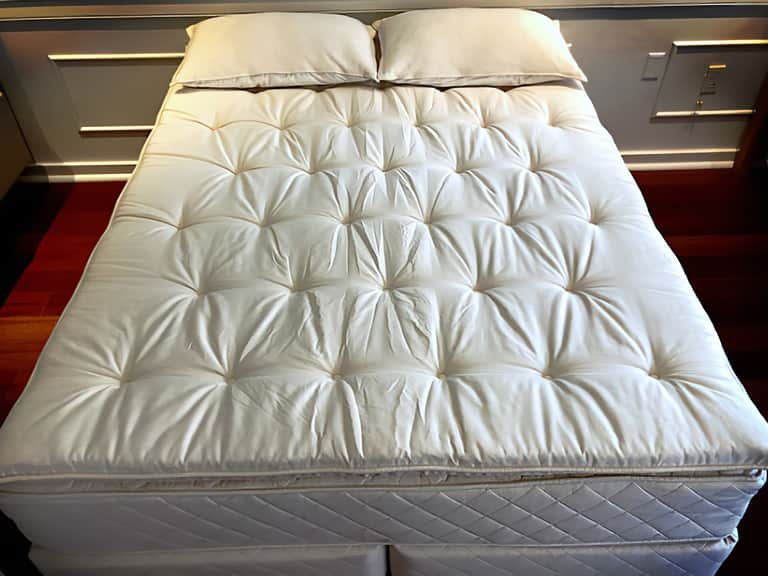
Construction has a direct relationship to care. A pad with quilted or tufted sections may keep its fill more evenly distributed, though seams and stitching need to be treated gently. A pad that uses elastic straps is easy to position, but those straps may require care to avoid stretching. A fitted style may offer a smoother fit, provided it matches the mattress depth. Consider how often you expect to remove the pad, air it, or clean it.
Before settling on a size, measure the mattress rather than relying solely on its labelled size. Check both its length and width, as well as the depth. If you use a mattress topper or another layer, account for that additional height when evaluating fit. Read the product’s sizing guidance, especially if the bed has an unusual profile or adjustable base.
Care instructions deserve the same attention as material claims. Some wool pads can be gently hand-washed or washed on a specified delicate cycle; others should not be immersed. Drying methods can differ, and heat or agitation may cause shrinkage, felting, or distortion. If a washable product is important to you, verify the instructions before purchasing instead of assuming that wool can be treated like cotton bedding.
- Check the fiber content, cover material, and construction.
- Confirm what any organic certification applies to.
- Measure mattress depth as well as the standard bed dimensions.
- Choose between straps, fitted edges, or another attachment style based on your setup.
- Read the care label and confirm whether the pad is washable or intended to be aired and spot-cleaned.
- Keep moisture-management claims distinct from waterproof protection.
Layering a wool pad into the bed
For most setups, the order is straightforward: mattress, wool pad, fitted sheet, then the rest of the bedding. The pad should lie flat and secure before the sheet goes on. Smooth out folds and check that corner straps, if present, are positioned correctly. A well-fitted layer is more comfortable and less likely to migrate as the bed is used.
Layering can become more complicated when a mattress already has a built-in pillow top, a separate foam topper, or a protective encasement. There is no universal rule that every bed needs every layer. Start with the function you want to add. If the goal is a slightly softer, more moisture-managing surface, a wool pad may be enough. If you also need full mattress encasement or a waterproof barrier, decide where those functions belong and check that the layers fit together without compressing or bunching.
Sheets should fit comfortably over the finished bed. If a new pad makes the fitted sheet strain at the corners, slips off, or pulls unevenly, the combined depth may be greater than the sheet can accommodate. A sheet with suitable pocket depth can solve the practical issue, while removing an unnecessary layer may restore a cleaner fit. The aim is not to build the thickest possible arrangement; it is to create a stable, breathable surface that feels right to sleep on.
With an adjustable bed, movement makes fit especially important. Test the setup through the bed’s usual range of positions, and check that the pad does not pull away or bunch. Follow any specific manufacturer guidance for the mattress and accessory layers. A pad should work with the bed’s movement rather than resisting it.
Care that respects wool fibers
The most important rule of wool pad care is the least glamorous: follow the maker’s instructions. Wool is resilient, but it is not immune to damage. Hot water, aggressive agitation, unsuitable detergents, high-heat drying, and unnecessary washing can shrink or felt the fibers. A pad that is intended for airing and spot cleaning should not be put through a standard wash cycle simply because other bedding is washable.
Regular airing is often a gentle first step. Remove the pad and let it air in a well-ventilated, shaded place, following any care advice supplied with it. Fresh air can help release accumulated odors and humidity. Avoid leaving wool in intense direct sunlight for extended periods unless the manufacturer specifically recommends it. The objective is to refresh the fibers, not expose them to unnecessary heat or prolonged weather.
For a small mark, begin with the care label. Spot-cleaning may be appropriate, but use a restrained amount of water and avoid rubbing vigorously. Blotting is generally gentler than scrubbing. If the pad has become heavily soiled, has absorbed a substantial spill, or is difficult to clean at home, consult the manufacturer for a suitable cleaning method. A specialist cleaner may be preferable to an improvised treatment that risks damaging the filling.
If washing is permitted, use only the cycle, water temperature, and detergent specified. Do not assume that a “gentle” setting is suitable for every construction. Afterward, follow the recommended drying method and make sure the pad is completely dry before returning it to the mattress. Trapped moisture can affect the bedding beneath and leave the pad feeling unpleasant. Avoid twisting or wringing unless the care instructions explicitly allow it.
It is sensible to protect the pad from avoidable strain, too. Lift it by its fabric rather than pulling hard on a single strap, and store it clean and thoroughly dry in a breathable place. Compressing it for a long period may affect its loft, depending on its construction. When it is not in use, a clean linen closet or breathable storage bag is generally a more considered choice than a damp or airtight space.
Common questions about wool bed pads
Does a wool bed pad make a mattress waterproof?
No. Wool can absorb moisture vapor and help manage everyday humidity, but that does not mean a pad will stop liquid from reaching the mattress. For spill protection, choose a product explicitly described as waterproof or water-resistant and check its materials and care requirements.
Is a wool mattress pad the same as a wool topper?
Not necessarily. A pad is typically a thinner layer focused on surface protection and moisture management, while a topper is generally intended to make a more noticeable change to cushioning. Names are not standardized, so compare thickness, filling, construction, and stated purpose.
Can a wool pad be machine-washed?
Only if the manufacturer’s care instructions say that it can. Wool pads vary in construction, and washing or drying in the wrong conditions can cause shrinkage, felting, or damage. Check the label before cleaning, and do not treat all wool bedding alike.
How often should a wool pad be aired?
There is no single schedule that suits every home or product. Airing it when it feels humid or needs refreshing is a practical approach, while the maker’s guidance should take precedence. Keep it in a ventilated place and avoid prolonged exposure to conditions the label advises against.
Will a wool pad change how my mattress feels?
It may add a modest layer of softness, but the effect depends on its thickness and filling. A thin protective pad is unlikely to transform a mattress in the way a substantial topper might. If a dramatic change in cushioning is your priority, compare topper construction rather than relying on a pad to solve a support or comfort mismatch.
A more thoughtful kind of comfort
A wool bed pad is at its best when its role is clearly understood. It can add a natural-fiber layer, help manage moisture vapor, and bring a subtle refinement to the surface of a bed. It is not automatically a topper, a waterproof protector, or a cure for an uncomfortable mattress. That clarity makes it easier to choose a pad that suits your habits rather than buying a layer for the promise of a vague upgrade.
Look closely at fiber content, certification details, attachment, sizing, and care. Consider the full stack of bedding, from the mattress upward, and decide which function is actually missing. With careful selection and gentle maintenance, a wool pad can become a useful, quietly luxurious part of an organic bedding system: not an extravagant flourish, but a thoughtful layer whose value lies in how well it works.